
|
The
Power of the Daleks
By
Alan Stevens and Fiona Moore

A version of this article was originally published in Celestial Toyroom Issue 311
"The Power of the Daleks" is one of those stories which has acquired a 'classic' status, somewhat out of keeping with the reality. Although very little survives of the recorded episodes, the release of the adventure as an animation reveals that, while it does have some positive elements, it is let down by characterisation, plot and its overall attitude to politics.
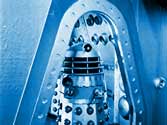 Dalek creator Terry Nation had first refusal on all Dalek stories, but he was too busy working on ITC's The Baron to write for Doctor Who, allowing David Whitaker to take on the job. Whitaker began by reworking elements from the 1965 Whitaker/Nation stage play The Curse of the Daleks,
in which a crewman from a spaceship forced to land on the planet Skaro,
revives the dormant Daleks in their city, intending to use them as his
servants (the Daleks, of course, decide otherwise). Whether
intentionally or not, "Power" also recalls the classic 1959 serial Quatermass and the Pit,
in that both involve the recovery of a long buried alien craft. Sydney
Newman, then the BBC's Head of Drama, was, however, unhappy with the
somewhat generic characterisation of the new Doctor. Reportedly,
because of the short notice, David Whitaker was unavailable to make
revisions and story editor Gerry Davis was otherwise engaged with
co-writing "The Highlanders", so the task fell to Dennis Spooner. This
he did uncredited, whilst studio recording was suspended for one week.
Spooner also found himself having to trim the script to a reasonable
length because Whitaker had a tendency to overwrite.
Dalek creator Terry Nation had first refusal on all Dalek stories, but he was too busy working on ITC's The Baron to write for Doctor Who, allowing David Whitaker to take on the job. Whitaker began by reworking elements from the 1965 Whitaker/Nation stage play The Curse of the Daleks,
in which a crewman from a spaceship forced to land on the planet Skaro,
revives the dormant Daleks in their city, intending to use them as his
servants (the Daleks, of course, decide otherwise). Whether
intentionally or not, "Power" also recalls the classic 1959 serial Quatermass and the Pit,
in that both involve the recovery of a long buried alien craft. Sydney
Newman, then the BBC's Head of Drama, was, however, unhappy with the
somewhat generic characterisation of the new Doctor. Reportedly,
because of the short notice, David Whitaker was unavailable to make
revisions and story editor Gerry Davis was otherwise engaged with
co-writing "The Highlanders", so the task fell to Dennis Spooner. This
he did uncredited, whilst studio recording was suspended for one week.
Spooner also found himself having to trim the script to a reasonable
length because Whitaker had a tendency to overwrite.
As a consequence, the serial is fragmented and badly structured, even if it does seem to be very good in production terms. Tristram Cary's excellent score from "The Daleks" (AKA "The Mutants") is reused to great effect, the set design is striking, and the surviving sequences well-directed. We also get some iconic imagery: the Doctor regenerating; the scientist, Lesterson, putting the Dalek through its paces; the Dalek production line; and the final shootout. The fact certain elements recur in the 1975 "Genesis of the Daleks" proves the point that a compelling/dynamic script was needed to create a truly impressive adventure. Accordingly, "Power" requires at least an extra draft. Whereas parts One, Two and Six are well-paced, the middle three are less so, and the whole plot could have been resolved over four episodes.
 In
the serial's defence, the regulars are, on the whole, well-written and
portrayed, with Patrick Troughton giving the Doctor an almost manic
quality which would, unfortunately, be toned down as the season
progressed. The regeneration (which isn't named as such) is never
explained, and this greatly benefits the story. The Doctor says that it
is "part of the Tardis" without which he couldn't survive. He refers to
his metamorphosis as a renewal, comparing himself to a butterfly
emerging from its chrysalis (contradicting producer Innes Lloyd's
assertion that it was a rejuvenation). One curious thing is that, under
his cloak, the Doctor's clothes are transformed too; the only item of
apparel he gets out of the chest is his coat. The rehearsal script
hints that he has changed appearance several times before, as well as
containing references to his granddaughter Susan. Given the questions
this would have raised, it's just as well that they were excised.
In
the serial's defence, the regulars are, on the whole, well-written and
portrayed, with Patrick Troughton giving the Doctor an almost manic
quality which would, unfortunately, be toned down as the season
progressed. The regeneration (which isn't named as such) is never
explained, and this greatly benefits the story. The Doctor says that it
is "part of the Tardis" without which he couldn't survive. He refers to
his metamorphosis as a renewal, comparing himself to a butterfly
emerging from its chrysalis (contradicting producer Innes Lloyd's
assertion that it was a rejuvenation). One curious thing is that, under
his cloak, the Doctor's clothes are transformed too; the only item of
apparel he gets out of the chest is his coat. The rehearsal script
hints that he has changed appearance several times before, as well as
containing references to his granddaughter Susan. Given the questions
this would have raised, it's just as well that they were excised.
At the end of the adventure the Doctor suggests using Bragen's interior guards to delay the Daleks, but ignores Ben's idea to simply switch off the power to defeat them, with the result that the colony's power supply is destroyed. This action makes him seem uncaring, as well as obsessive, which is at odds with his portrayal as a shrewd, but generally benign figure elsewhere in the story. Why doesn't he, for instance, have the colonists evacuate the area, then cut the power, smash the junction boxes and wait for the Daleks to run down? It's as if the Doctor can only contemplate obliterating the Daleks and to hell with the consequences. There is some attempt to ameliorate his decision by scripting a Dalek to say that "Static power is being stored. We can dismantle the human electric system", but this is a ridiculous statement, as clearly the Daleks will need to keep recharging.
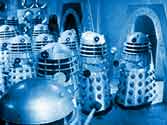 There
is, in general, a rather unsubtle presentation of the Daleks
throughout: as, for example, when one says, "A Dalek is bet-- is not
the same as a human"; a piece of dialogue which makes it sound like a
pantomime villain. Somewhat problematically, the inert Daleks are
covered in cobwebs, leaving one to ponder how this occurred whilst
aboard a ship submersed in a mercury swamp. (Do they even have spiders
on Skaro?) The fact that the Dalek mutants have survived for an unknown
length of time (possibly more than two hundred years) without power,
further demonstrates that those left for dead at the end of "The
Daleks" were still alive. And, although the Doctor agrees with Ben that
the first Dalek to be revived recognises him, this may not be the case.
It also treats Resno with suspicion, which implies that it was not
actively acknowledging an old enemy, but simply picking up on the
Doctor's hostility.
There
is, in general, a rather unsubtle presentation of the Daleks
throughout: as, for example, when one says, "A Dalek is bet-- is not
the same as a human"; a piece of dialogue which makes it sound like a
pantomime villain. Somewhat problematically, the inert Daleks are
covered in cobwebs, leaving one to ponder how this occurred whilst
aboard a ship submersed in a mercury swamp. (Do they even have spiders
on Skaro?) The fact that the Dalek mutants have survived for an unknown
length of time (possibly more than two hundred years) without power,
further demonstrates that those left for dead at the end of "The
Daleks" were still alive. And, although the Doctor agrees with Ben that
the first Dalek to be revived recognises him, this may not be the case.
It also treats Resno with suspicion, which implies that it was not
actively acknowledging an old enemy, but simply picking up on the
Doctor's hostility. 
We should also note that, despite the camera script's reference to a "terrible, claw like hand", and Ben's dialogue which describes "a sort of claw" as was seen in "The Daleks", the adult Dalek mutant in the telesnaps seems more in line with the blobby, tentacled creatures depicted in the Dalek adventures from the 1980s. Additionally, the on-set photographs taken during the recording of the Dalek production line sequence, appears to show a mutant similar to the "embryo" that featured in "The Daleks' Master Plan".
Other characters fare as badly. Bragen indicates, in the same conversation with Janley in Episode Three, that he is not directly involved with the rebels, but is using her as his contact, yet by the next episode he is the rebels' 'Mr Big', attending their secret meeting. When Valmar is repairing the communications desk in Episode Four, Bragen, by then Deputy Governor, is quite aggressive towards him, which is unusual behaviour to show one's allies, and his ruse during Episode Six with the gun, where it is implied that he would have shot Janley if she had refused to back his plan, is somewhat careless, as it demonstrates that he is not to be trusted. Lesterson fares a little better (the fact that he apparently keeps late hours is a nice touch) but even here, the scene where he (understandably) goes mad after discovering that the Dalek ship includes a manufacturing operation as well as being dimensionally transcendental, is quite over-the-top, reminiscent of Kenneth Williams in the contemporary film Carry On Screaming, albeit less subtle. And why doesn't it occur to him to respond to Janley's threat of blackmail over Resno's death with a counter-blackmail over her involvement with the rebels?
 The
culture of the colony is also poorly thought out. It is said to be a
well-established mining community, so it's odd that no one misses Resno
when he is killed by the resuscitated Dalek: surely he would have had
friends and/or family looking for him? One might also ask why, when
Resno collapses and Lesterson goes to get help, he is later unaware
that Resno has died. Janley tells Bragen she disposed of Resno's body
in the mercury swamp, so Lesterson obviously failed to return with the
promised assistance! For that matter, there is only scant evidence of
family or any other life outside of the colonists' work and/or
political activities. It is unclear when the story takes place, yet it
evidently occurs before "The Dalek Invasion of Earth"
as the colonists are unfamiliar with the creatures. Despite various
sources giving the date as 2020 (which would, of course, have seemed
more credible in 1966), none is cited in the dialogue itself. Governor
Hensell does say that the Dalek capsule predates the colony by
centuries, and Lesterson suggests an age of two hundred years ("at
least") for it, but there is no indication of how these figures were
happened upon. The name "Vulcan" is plainly meant to refer to the
hypothetical planet once believed to lie in orbit between Mercury and
the Sun. Indeed, Vulcan is also shown on the "chart of the solar
system", presented by the Golden Emperor of the Daleks during the comic
strip Invasion of the Daleks. This occurs in the 1964 annual The Dalek Book.
The
culture of the colony is also poorly thought out. It is said to be a
well-established mining community, so it's odd that no one misses Resno
when he is killed by the resuscitated Dalek: surely he would have had
friends and/or family looking for him? One might also ask why, when
Resno collapses and Lesterson goes to get help, he is later unaware
that Resno has died. Janley tells Bragen she disposed of Resno's body
in the mercury swamp, so Lesterson obviously failed to return with the
promised assistance! For that matter, there is only scant evidence of
family or any other life outside of the colonists' work and/or
political activities. It is unclear when the story takes place, yet it
evidently occurs before "The Dalek Invasion of Earth"
as the colonists are unfamiliar with the creatures. Despite various
sources giving the date as 2020 (which would, of course, have seemed
more credible in 1966), none is cited in the dialogue itself. Governor
Hensell does say that the Dalek capsule predates the colony by
centuries, and Lesterson suggests an age of two hundred years ("at
least") for it, but there is no indication of how these figures were
happened upon. The name "Vulcan" is plainly meant to refer to the
hypothetical planet once believed to lie in orbit between Mercury and
the Sun. Indeed, Vulcan is also shown on the "chart of the solar
system", presented by the Golden Emperor of the Daleks during the comic
strip Invasion of the Daleks. This occurs in the 1964 annual The Dalek Book.
 The
rebellion, furthermore, is largely unexplained. Janley remarks that the
colony is "running down" and that the rebels will bring in better
facilities and additional money, but people generally need more
substantial reasons than grotty rec-rooms to start plotting the armed
overthrow of their government. In any case, Resno contradicts Janley
saying, "We're doing all right as we are. Or we were until your lot
came along stirring things up." Lesterson describes the rebels as a
"pressure group", which again does not sound like the kind of
organisation which goes about planning bloody revolts. Hensell isn't a
despot, and is even said to be popular; Bragen, in fact, is the only
one with any sort of grievance, in that he is disrespected by the
Governor and his Deputy. Everyone bar Hensell seems to know who the
rebels are, which is surely counterproductive.
The
rebellion, furthermore, is largely unexplained. Janley remarks that the
colony is "running down" and that the rebels will bring in better
facilities and additional money, but people generally need more
substantial reasons than grotty rec-rooms to start plotting the armed
overthrow of their government. In any case, Resno contradicts Janley
saying, "We're doing all right as we are. Or we were until your lot
came along stirring things up." Lesterson describes the rebels as a
"pressure group", which again does not sound like the kind of
organisation which goes about planning bloody revolts. Hensell isn't a
despot, and is even said to be popular; Bragen, in fact, is the only
one with any sort of grievance, in that he is disrespected by the
Governor and his Deputy. Everyone bar Hensell seems to know who the
rebels are, which is surely counterproductive.
 It's
equally puzzling that the rebels are cooperating with Bragen in the
first place: he is, after all, Head of Security, a strict
disciplinarian, and angling to become governor. Nor is it obvious why
they need the Daleks as a weapon, because it is Bragen, not Hensell,
who has control over the security forces. And why is Janley anxious
about the meeting being overheard by guards when they are answerable to
Bragen and therefore not likely to turn against him? In any case, the
rebels are so well-armed to begin with, that the presence or absence of
the Daleks will not make much difference to their success. The idea of
Bragen having a Dalek kill Hensell and then declare martial law, is
fair enough, but it's perplexing that he's involved with the rebels,
let alone that he arranges the Dalek test firing in Rocket Room P for
them, instead of just acting on his own.
It's
equally puzzling that the rebels are cooperating with Bragen in the
first place: he is, after all, Head of Security, a strict
disciplinarian, and angling to become governor. Nor is it obvious why
they need the Daleks as a weapon, because it is Bragen, not Hensell,
who has control over the security forces. And why is Janley anxious
about the meeting being overheard by guards when they are answerable to
Bragen and therefore not likely to turn against him? In any case, the
rebels are so well-armed to begin with, that the presence or absence of
the Daleks will not make much difference to their success. The idea of
Bragen having a Dalek kill Hensell and then declare martial law, is
fair enough, but it's perplexing that he's involved with the rebels,
let alone that he arranges the Dalek test firing in Rocket Room P for
them, instead of just acting on his own.
 The
plot is riddled with problems. One might excuse the continuity errors,
when the Doctor alludes to meeting Saladin (which he didn't, and, as
Whitaker scripted "The Crusade", isn't a mistake the writer would have
made himself) and describes his former incarnation as "a great
collector" (which he wasn't) and suddenly reveals that he kept a diary
(which was undoubtedly a retcon on the part of the production team to
introduce the idea of the Doctor consulting previous entries) on the
grounds that attitudes to the programmes' history at the time were
fairly haphazard. It's less easy to forgive the note explaining Polly's
kidnapping (that she will remain safe "as long as you leave the Daleks
alone"): a reason so artless, that it exposes the fact that Anneke
Wills was on holiday during the recording of Episode Four. Michael
Craze's absence in Episode Five (Ben is abducted following his
discovery at the rebel's secret meeting) is only slightly better
handled. It also appears strange that, if Lesterson had removed a Dalek
to experiment on, he didn't put it back for the Doctor to find and
thereby avoid suspicion.
The
plot is riddled with problems. One might excuse the continuity errors,
when the Doctor alludes to meeting Saladin (which he didn't, and, as
Whitaker scripted "The Crusade", isn't a mistake the writer would have
made himself) and describes his former incarnation as "a great
collector" (which he wasn't) and suddenly reveals that he kept a diary
(which was undoubtedly a retcon on the part of the production team to
introduce the idea of the Doctor consulting previous entries) on the
grounds that attitudes to the programmes' history at the time were
fairly haphazard. It's less easy to forgive the note explaining Polly's
kidnapping (that she will remain safe "as long as you leave the Daleks
alone"): a reason so artless, that it exposes the fact that Anneke
Wills was on holiday during the recording of Episode Four. Michael
Craze's absence in Episode Five (Ben is abducted following his
discovery at the rebel's secret meeting) is only slightly better
handled. It also appears strange that, if Lesterson had removed a Dalek
to experiment on, he didn't put it back for the Doctor to find and
thereby avoid suspicion.
What is more, although a button was planted on the Doctor that (falsely) linked Deputy Governor Quinn with the murder of the Examiner from Earth, it takes the Doctor the best part of two days to make the connection, even though from the telesnaps it's apparent that, during the whole time, Quinn was wondering around with one button missing from the front of his jacket.
Another problem is that Janley and her allies don't seem to think through their actions vis-a-vis the Daleks. While it does feature a strong running theme about the extent to which people can ignore the obvious when it contradicts something that they really want to believe, it brushes against the unrealistic in a number of places. Janley drugs Lesterson before the test firing, and patently mistrusts the Dalek, ensuring that it has an external constraint placed upon its weapon. Yet it doesn't seem to worry her that the creature might tell Lesterson that an armed rebellion is being planned.
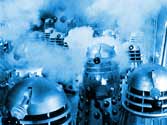 She
also fails to query why the Dalek complies with them at all. If she is
supposed to be duplicitous enough to be leading the rebels on, then its
repeated claim that it is humanity's servant should not be enough to
lull her into such complacency.
She
also fails to query why the Dalek complies with them at all. If she is
supposed to be duplicitous enough to be leading the rebels on, then its
repeated claim that it is humanity's servant should not be enough to
lull her into such complacency.
In addition, Janley's reactions to information that the Daleks are procreating seem entirely counterintuitive. When Lesterson wants to talk to the Doctor about the suspicious amounts of material the Daleks are using, Janley blackmails him into silence, and when the Doctor intimates that the Daleks are not just machines and are replicating themselves, she has him thrown out of Lesterson's laboratory. In both cases, Janley has no reason to conceal the Daleks' activities, and it could be to her advantage (in terms of sheer self-preservation) to investigate what they are up to. As it is, when Lesterson confirms that the Daleks are reproducing, and tries to see the Govenor, Janley pretends that he is mad.
On a more positive note, the serial does contain some interesting themes. Whereas earlier Dalek encounters gradually built up the creatures' capabilities to the point where, in "Master Plan", they are capable of literally taking over the known universe, "Power" refreshes the sense of drama by changing the focus to a small group of Daleks in a weakened state, gradually reaching the point where they can destroy the colony. There is also a rather nice spot of parallelism between the regenerated Doctor and his newly-invigorated adversaries, in that the Dalek point-of-view shot of the Doctor, following its revival, echoes an earlier scene when we view Ben and Polly from the still-unsteady Doctor's perspective.
Nevertheless, the adventure, unfortunately, lacks any of the political allegories previously woven into "The Daleks", "Invasion of Earth" and "Master Plan". Whereas the former stories are, retrospectively, a subtle reworking of postwar West German politics (renewed pacifism in the shadow of genocidal aggression); life under enemy occupation; and Cold War geopolitics; "Power" is not anything like as smart, eschewing its moral perspective to the point where the Daleks seem almost justified in their attempt to wipe out such a vicious, backstabbing and murderous colony of scumbags. Which, in our view, taken alongside a dodgy plot and inconsistent characterisation, warrants an instant demotion for the serial from 'Classic A+ Who' to a B rated 'Could do better!'.
Image effects by Fiona Moore

